Bathroom Tiles Design in Dubai: Floors, Walls, Colours and Layouts by Bathroom Type
Dubai Repair Pro is a Dubai LLC with its own team of tile installers. We tile and waterproof bathrooms, and washrooms, across Dubai, and most of the design questions we hear come before the first tile is bought: which colour, which size, how high up the wall, whether the floor should match, how to make a small bathroom look bigger.
Last updated: 16 October 2026
On this page
- Plan the bathroom first, then choose the tile
- Bathroom floor tiles design: pairing the floor with the walls
- Wall tiles for bathroom walls: height, zones and features
- Colour schemes: white, grey, warm neutrals and dark
- Layouts and patterns
- Marble-effect, stone-look, concrete-look and mosaic bathrooms
- Small, windowless and rented bathrooms
- Master, guest, powder room, en-suite and maid's room bathrooms
- Lighting, mirrors and glass
- Grout colour and joint width
- Design mistakes and trade-offs
- A planning checklist and the sample-board routine
- Budget: where to spend and where to save
- How we work on a bathroom
- Frequently asked questions about bathroom tiles design
This page is a guide to those design decisions. It covers how to plan a bathroom before choosing tile, how to pair floor and wall tiles, how colour schemes behave in real bathrooms, which layouts suit which rooms, how to treat a master bathroom, a guest bathroom, a powder room and a maid's room differently, and which choices people regret. It does not repeat the technical side. Slip ratings, falls to the drain, waterproofing, materials and how we quote are in our bathroom and kitchen tiles guide, and the ratings that appear on tile boxes are explained in our floor tiles design guide.
The table is the short version, and the rest of the page gives the reasons.
| Bathroom type | A sensible tile approach | Watch for |
|---|---|---|
| Master bathroom | Large-format porcelain or marble-effect on walls, a textured matching tile on the floor, one feature wall | Too many materials in one room |
| Guest bathroom | One calm tile on walls and floor, a single accent | Over-designing a room people use briefly |
| Powder room | The place for a bold tile, pattern or dark colour | Mirror and light placement |
| En-suite | Match or echo the bedroom's tones | Steam reaching the bedroom |
| Small or windowless bathroom | Light colours, few joints, one tile throughout | Dark tile that makes the room feel smaller |
| Maid's room and utility bathroom | Practical ceramic walls and a grip-rated floor | Spending where it does not show |
| Rented bathroom | Neutral, durable, repair-friendly | Bold colours the next tenant will not want |
To start, send photos and the bathroom size on WhatsApp at +971 55 209 9785. A site inspection costs AED 100.
Plan the bathroom first, then choose the tile
Tile is the last decision in a bathroom, not the first. The positions of the fixtures decide where the tile is cut, where the joints fall and which walls are seen. Choosing a tile before you know them is how people end up with a feature wall that is hidden by a vanity.
Decide these before you buy tile
- The layout of fixtures. Where do the toilet, basin, vanity, shower and bath go? Moving them later costs far more than moving a tile choice.
- The shower screen and its position. A glass screen covers part of a wall and stops the tile at its edge. Know where it falls.
- The niche or shelf. A niche is a design feature as well as storage. Its position should line up with the tile joints.
- The mirror and lights. The mirror position decides which wall is the feature wall, and the lights decide how the colour reads.
- The tile height on the walls. Floor to ceiling, or to a set height. This changes the quantity of tile and the look.
- The door and any step. The threshold meets the floor tile and sets its pattern direction.
- The ventilation. An extractor fan or a window, which affects how the room dries and which colours stay clean.
Mark out before you order
On a good job, the installer marks the tile layout on the wall and floor before fixing, so the cuts fall where you want them. A full tile at eye level, with the cuts at the floor or the ceiling, looks better than the reverse. Ask to see the layout marked out, or laid dry, before any adhesive goes on. It takes minutes and prevents a thin sliver of tile in the most visible corner.
A drawing is useful, even a rough one
Draw the room on paper, mark each wall A, B, C and D, and note where each fixture, the mirror and the screen go. Show it to the installer at the inspection. We use it to agree the layout on site.
Bathroom floor tiles design: pairing the floor with the walls
The floor and the walls are one picture. How you pair them is the biggest design choice in a bathroom, and there are five common ways.
| Pairing | What it looks like | Good for | Watch for |
|---|---|---|---|
| Same tile, floor and walls | Continuous, calm | Small bathrooms, modern minimal rooms | A grip-rated tile that is also pleasant on the wall |
| Same design, two finishes | A polished or glossy wall, a textured floor | Most homes: looks matched, grips on the floor | Making sure the two finishes come from one range |
| Floor and wall in the same colour family | Related but not identical | Master bathrooms | Colours that nearly match and look like a mistake |
| Contrast: dark floor, light walls, or the reverse | A graphic, defined room | Larger bathrooms, powder rooms | A dark floor shows marks |
| Floor as the feature | A patterned floor with plain walls | Guest bathrooms and powder rooms | A busy pattern with strong wall colour |
A bathroom floor that is the star
A patterned or mosaic floor, with simple walls, gives a lot of character for a small area of tile. Because a bathroom floor is a few square metres, a special tile costs far less in total than the same tile would in a living room. This is one of the best places to spend.
Bathroom floor tiles design that works with the shower
The shower floor is part of the bathroom floor. Many designs run the same tile across the main floor and into the shower, using a smaller tile or a mosaic in the shower where the floor falls to the drain. Others change the tile at the shower threshold, which marks the wet zone. Small tiles follow the slope of a shower floor more easily, and large tiles need the slope cut into them. Fixing and falls are covered in our bathroom tiles guide.
Borders, bands and inlays
A border tile around the edge of the floor, or a band of contrasting tile at one height on the wall, adds structure to a plain room. Keep it simple: one band, one border, and one colour.
Tiles for bathroom floor use: choose the surface for the user
A bathroom floor is walked on wet and barefoot. A matt or textured surface is the starting point when choosing tiles for bathroom floor areas, with the grip rating checked on the data sheet. The details of ratings are in our floor tiles design guide. A polished floor is a design choice that comes with a slip risk, and a polished wall with a textured floor in the same design keeps the look and the grip.
Bathroom floor tile, door line and corridor
The tile ends at the door. Decide whether the bathroom floor tile continues into the corridor, meets a threshold strip or changes at the door line. A threshold also holds back water, and a clean line at the door looks tidy in photographs and in use.
Wall tiles for bathroom walls: height, zones and features
Walls are where most of the design happens, because they are what you look at.
How high to tile
| Height | Look | Cost and care | Best for |
|---|---|---|---|
| Floor to ceiling | Rich and complete; easy to wipe | The most tile and labour | Showers, master bathrooms, small rooms |
| To a set height (such as door height) | Practical, a clean line | Moderate | Guest bathrooms |
| Half height (such as to the top of the vanity) | Traditional, economical | Less tile, painted wall above | Maid's rooms, utility bathrooms |
| Wet zones only | Tile the shower and splash area | Least | Rented properties |
In a wet zone such as a shower, tile to the ceiling. Anywhere else, the choice is yours. A painted wall above a tiled lower half needs a moisture-resistant paint, which we cover on our interior painting page.
Full-height wall tiles
Floor-to-ceiling tile gives a calm, finished room, and large-format tiles with few joints suit it best. A tall tile running up to the ceiling draws the eye up and makes the room feel taller. Rectified tiles allow a tight joint and a clean look.
Feature walls
One feature wall is a design device: the wall behind the vanity, the wall in the shower or the wall you see from the door. Make it different by tile, pattern or colour, and keep the other walls plain. Two feature walls compete.
The wall behind the vanity and the mirror
This is the wall that is seen most. Plan the mirror, any lighting and the taps against the tile joints so a joint does not cut through a tap hole or a mirror edge.
Niches
A recessed niche looks neat when it is sized to the tile, with its edges and shelves at joint lines. A tiled niche in a contrasting tile makes a feature. A niche too close to the shower head gets wet constantly, and one placed where the screen meets the wall is awkward to clean.
Best tiles for bathroom walls
The best tiles for bathroom walls are the ones that suit the wet zones and the look you want. Glazed ceramic is the usual choice for walls. Porcelain suits wet zones and large formats. Mosaic suits a feature. Our porcelain vs ceramic guide explains the difference.
Corners, trims and edges
The edge of a tile where it meets a corner or an open side can be finished with a trim, a mitred join or a rounded edge tile. The choice changes the look from neat and modern to traditional. Decide it before the order, since trims are separate items.
Colour schemes: white, grey, warm neutrals and dark
Colour sets the mood of a bathroom, and it also decides what you see every day. Here is how the main schemes behave in a real bathroom.
White
White is bright, clean-looking and the easiest to match with fittings. It shows dark marks, mould in the grout, soap residue on a dark grout line and hair on the floor. Plain gloss white also shows every water streak. A white with a little texture, veining or tone variation hides marks better, and a warm white looks gentler under evening light than a cold white.
Grey bathroom tiles
Grey bathroom tiles are among the most popular choices because grey goes with nearly everything: chrome and black taps, wood-effect vanities, white sanitaryware. The shade is what matters.
- Light grey brightens a room and hides water marks well.
- Mid grey is the safest, hiding dust and splashes, and works with most fittings.
- Charcoal and dark grey look dramatic, and they show limescale, soap and drying marks more. They need more light.
- Warm grey (greige) feels softer than cool grey and looks better with timber and brass.
- Cool, blue-grey can feel cold in a room without a window.
Grey also changes with the light. Look at the sample in the bathroom itself, with the light on and off.
Warm neutrals
Beige, sand, cream and stone colours suit Dubai interiors, work with brass and brushed finishes and are forgiving of marks. They can look dated if the tone is yellowish, and they need the right lighting to avoid looking flat.
Dark and bold
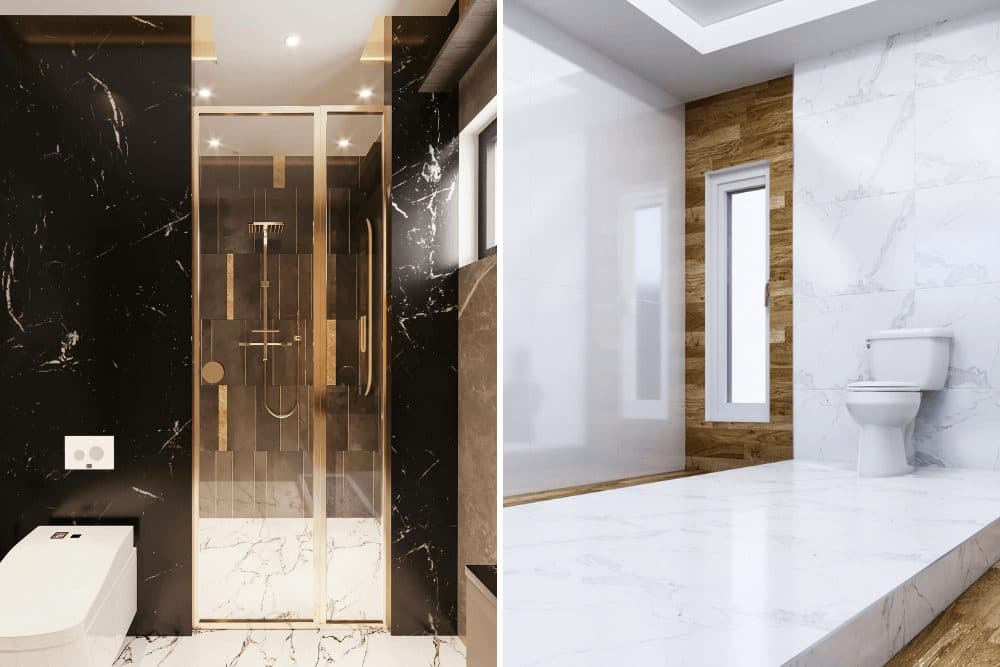
Black, deep green, navy and dark stone create a dramatic powder room. They work best in a small room with good lighting, and they are harder to keep looking clean. A matt dark surface hides water marks better than a glossy one.
Colour on the floor versus the wall
Darker on the floor and lighter on the walls feels grounded and keeps the room bright. Lighter on the floor and darker on the walls feels more theatrical and shows the floor marks. In a small room, keep both light.
Colour and fittings
Choose the tile and the taps together. Chrome suits cool tones, brass and gold suit warm ones, and black suits white, grey and stone. Bring the tap finish sample to the shop, since the colour reads differently against tile.
Layouts and patterns
The way tiles are laid changes the room as much as the tile itself.
| Layout | Look | Best for | Notes |
|---|---|---|---|
| Straight stack (grid) | Clean, modern | Large and small formats | Needs a precise base and straight joints |
| Brick bond (offset) | Classic, softer | Rectangular wall tiles | The usual offset is a half or a third of the tile |
| Vertical stack | Draws the eye up, raises the ceiling | Showers, narrow rooms | Narrow tiles suit it best |
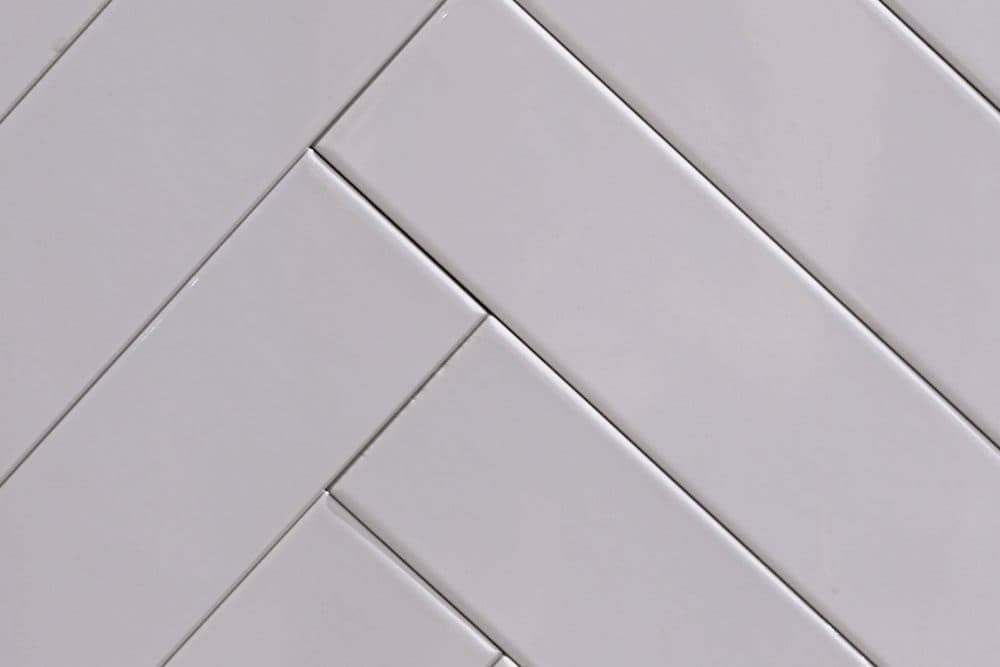
| Herringbone | Formal, patterned | Feature walls, floors | More cuts, more waste, slower |
| Chevron | Dynamic, directional | Feature walls | The most waste |
| Mosaic sheets | Small, textured | Shower floors, niches, borders | Many joints, so more grout to clean |
| Diagonal | Lengthens the room | Floors | More cuts at the edges |
| Mixed sizes | A modular, architectural look | Larger bathrooms | Needs a plan drawn first |
Direction matters
Horizontal tile makes a narrow room feel wider, and vertical tile makes a low ceiling feel higher. A bathroom that is long and narrow benefits from horizontal lines across the end wall. A bathroom with a low ceiling benefits from vertical lines.
Joint lines
Align the joints of the wall tiles with the edges of the vanity, the niche, the screen and the door where you can. Joints that line up make a room look planned. Joints that miss by a few millimetres make it look careless.
Pattern in moderation
A strong pattern is a feature. Use it on one wall or the floor, and keep the rest plain. A patterned floor, a patterned feature wall and a patterned border in one small room is too much.
Marble-effect, stone-look, concrete-look and mosaic bathrooms
Four looks dominate bathroom design. Each has an effect on care as well as appearance.
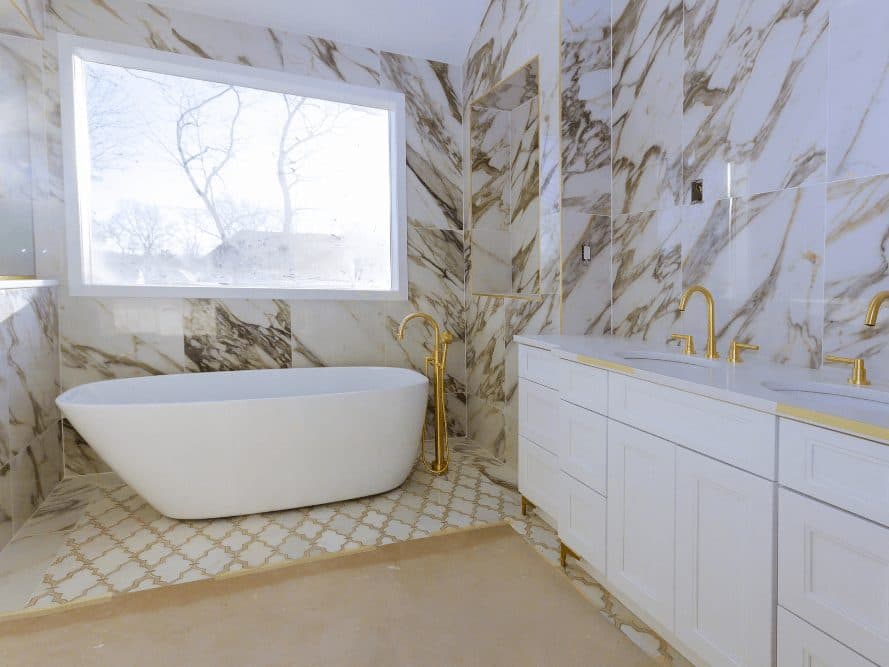
Marble-effect porcelain
It gives the veined look of marble with porcelain's low absorption and no sealing. In a bathroom it is the practical way to get the look. Large formats show the veining across a wall as a single picture. A polished marble-effect tile is elegant on a wall and slippery on a floor, so pair it with a textured floor in the same pattern.
Natural stone
Real marble, travertine and limestone are beautiful and varied. In a bathroom, they need sealing and gentle, suitable cleaners, because acid cleaners can etch some stones. Soap and hard water can mark them. They suit a master bathroom where the owner accepts the care. See our marble flooring guide for stone care.
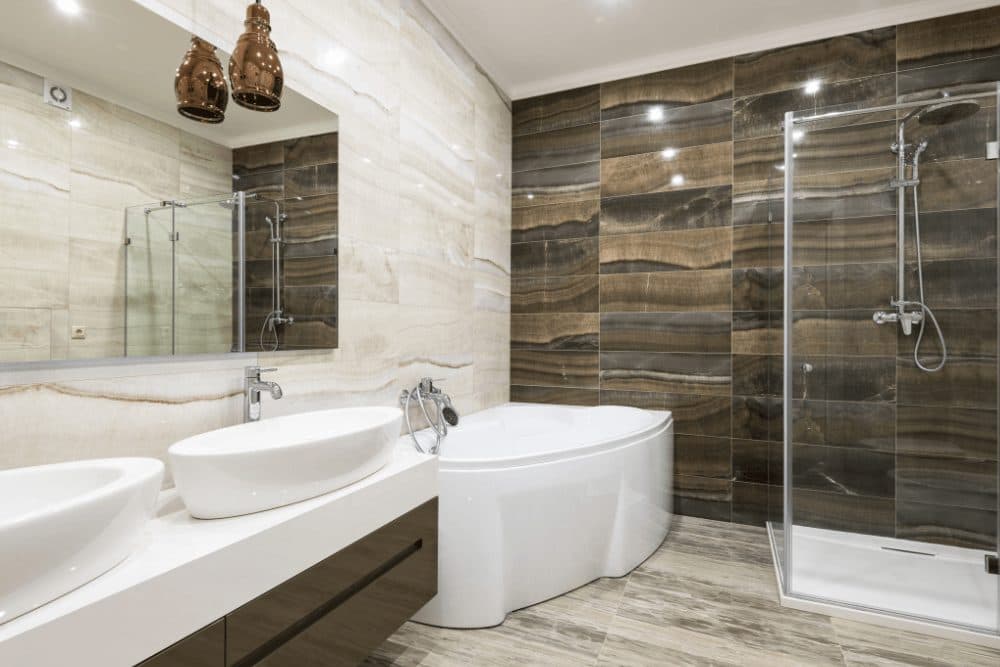
Concrete-look and stone-look porcelain
These give a modern, quiet look with a matt surface that hides marks well. In a large bathroom they feel architectural. In a small one they can look flat unless the lighting is good.
Mosaic
Mosaic is made from small pieces on a sheet. It follows curves and slopes, and it makes a strong feature in a niche, a shower floor or a band. Glass and metallic mosaics sparkle and reflect light. The trade-off is joints: more grout lines mean more to clean, and glass mosaic shows adhesive and grout flaws if the wall is not flat. A glass mosaic on a floor can be slippery.
Three-dimensional and relief tiles
Tiles with a raised pattern add texture to a feature wall. They collect soap and dust in the relief and need regular cleaning. Use them where the wall is not constantly splashed.
Large slabs
A large porcelain slab gives a nearly continuous wall with few joints. The trade-offs are weight, the need for a perfectly flat wall and the difficulty of replacing a damaged slab. If a slab cracks, the replacement is a bigger job than replacing a small tile.
Small, windowless and rented bathrooms
Small bathrooms are common in apartments, and a good design makes them feel more open.
Making a small bathroom look larger
- Use one tile on the floor and walls, or tiles in the same colour family, to remove visual breaks.
- Choose light colours, because dark tile closes a small room in.
- Use fewer joints with larger tiles, rectified, with a tight grout line in a matching colour.
- Tile to the ceiling for a taller look.
- Keep the pattern small or use one feature wall.
- Add light: a mirror opposite a light source doubles it.
- Use a glass screen instead of a curtain, so the shower does not cut the room.
- Choose a wall-hung vanity if the plumbing allows, to show more floor.
Windowless bathrooms
A bathroom with no window depends on artificial light and an extractor fan. Choose light, warm tones that bounce light, avoid very dark tile unless the lighting is strong, and check that the fan works and vents properly. A damp room without ventilation grows mould in grout and sealant whatever tile you choose. Our bathroom guide covers ventilation and grout care.
Rented bathrooms
If you are a tenant, changes to tile need your landlord's agreement. If you are a landlord, a neutral, durable tile in white, light grey or warm neutral suits most tenants and shows less wear. A bold colour that suits you may not suit the next tenant. Regrouting or replacing a few tiles is often a better fix than a full retile; see our guide.
Master, guest, powder room, en-suite and maid's room bathrooms
Bathrooms differ in how they are used, and the design should follow.
Master bathroom
This room is private and used daily. Spend on the surfaces you see and touch every day: the shower walls, the floor and the wall behind the vanity. Large-format tiles, a feature wall and a niche suit it. A master bathroom can carry richer materials, such as marble-effect or real stone, because the owner can look after them.
Guest bathroom
Guests use it briefly, so the design should be calm and easy to clean. A single tile on the floor and walls, with one accent, is enough. A small cost saved here can go to the master bathroom.
Powder room
A powder room has no shower, so it stays dry and is seen by every visitor. This is where a bold tile, a dark colour, a patterned floor or a dramatic marble-effect wall pays off. The area is small, so even an expensive tile costs little in total.
En-suite
An en-suite sits next to the bedroom. Echo the bedroom's tones so the two feel connected, and check the door and extraction, so that steam does not reach the bedroom.
Maid's room and utility bathrooms
Washroom tiles for a staff or utility room follow the same rules as any bathroom, with practicality first. These are used often and seen rarely. Practical ceramic walls and a grip-rated floor tile, in a light colour, are enough. Spend on waterproofing and falls, since a leak costs far more than a tile.
Shared family bathrooms
A bathroom used by children needs durable, wipeable surfaces and a grip-rated floor. Choose a mid-tone, avoid delicate stone and keep the pattern simple.
Lighting, mirrors and glass
Light changes the colour of tile more than any other factor.
- Natural light from a window shows the true colour and the texture. A north-facing or shaded window gives a cooler light.
- Warm LED bulbs make beige, cream and wood tones richer, and make cool greys look flatter.
- Cool white LED bulbs make white and grey look crisp, and can make warm tiles look yellow or dull.
- Mirrors double light and show the tile twice. A mirror opposite a feature wall repeats it.
- Glass screens let light through and keep the room open. Frosted glass hides the shower and still lets light in.
- Gloss and polish reflect light and sparkle, and show every mark. Matt surfaces absorb light and look softer.
Take the tile sample into the bathroom, hold it against the wall in daylight and then with the lights on. If you can, test it with the bulbs you plan to use.
Grout colour and joint width
Grout is a design element. It frames every tile, and it is the part that gets dirty first.
| Grout choice | Effect |
|---|---|
| Matching the tile | Joints disappear, the surface looks continuous |
| One shade darker | Hides dirt, stays neutral |
| Contrasting (such as dark on white) | Draws a grid, a graphic look |
| Epoxy grout | Stain-resistant and harder, suited to showers and wet rooms |
| Cement grout | Common, needs sealing |
Joint width
A narrow joint gives a cleaner look and suits rectified tiles on a flat wall. A wider joint suits handmade and uneven tiles. Your installer sets the joint to the tile maker's guidance.
White grout
White grout looks crisp on day one, and it stains in a floor or shower. If you want white tile with white grout, expect to clean it more often. A light grey is a sensible alternative. Our bathroom and kitchen tiles guide covers grout and sealant care.
Design mistakes and trade-offs
| Mistake | What goes wrong | The fix |
|---|---|---|
| Choosing tile before fixtures | Cuts and joints land in the wrong places | Fix the layout first |
| Polished tile on the floor | Slippery | A textured floor tile in the same design |
| Too many materials or patterns | The room feels busy | One feature, one pattern |
| Dark tile in a small, windowless room | The room closes in | Light colours and strong lighting |
| A bold colour in a rental | The next tenant dislikes it | Neutral base, accent in towels and fittings |
| Sample seen only in the shop | Colour changes at home | Test in the bathroom, with the lights on and off |
| Large slabs in a bathroom with a wall that is not flat | Lippage, cracked slabs | Flatten the wall first |
| Contrast grout without a plan | A grid that dominates | Choose grout with the tile |
| Ignoring the mirror and the vanity wall | A feature that is hidden | Plan the wall that is seen most |
| Saving on waterproofing | Leaks | Spend on the layers you cannot see |
Trade-offs to weigh
- Glass mosaic sparkles and is slippery and unforgiving of a poor wall.
- Polished stone looks luxurious and etches and slips.
- Large slabs look continuous and are heavy and costly to replace.
- White grout looks bright and stains.
- Dark glossy tile looks dramatic and shows every mark.
- Relief tile adds texture and collects soap and dust.
A planning checklist and the sample-board routine
- Measure each wall and the floor, and note the fixtures.
- Draw the room and mark the mirror, vanity, screen, niche and door.
- Choose the look: colour family, feature wall and layout.
- Choose the tile: type, size and finish for walls and floor, and check the ratings.
- Collect samples: the tile, the grout, the tap finish and a paint chip for the walls above.
- Build a sample board: place them together in the room and view them in the morning and in the evening.
- Agree the layout on site before fixing.
- Order extra for cuts and spare tiles from the same batch.
- Confirm the waterproofing and the schedule with the installer.
Budget: where to spend and where to save
Tile prices vary with the material, size, finish and where you buy, and we do not publish them on this page. The decision is how to share a budget across the room.
Spend on
- Waterproofing and falls, which you cannot see.
- The surfaces you see and touch daily: shower walls and floor.
- A feature that matters to you.
- Grip on the floor.
Save on
- Walls that are hidden by fittings.
- Guest and utility bathrooms.
- Trims and decorations beyond the one feature.
- Moving fixtures that already work.
The labour in a bathroom is high compared with the area, because of the cuts, the waterproofing and the detail. Complex layouts, large slabs and mosaics add to it. How we quote and what changes a quote are in the bathroom and kitchen tiles guide.
How we work on a bathroom
We employ our own installers and do not subcontract the tiling.
- Send photos of the bathroom and your ideas on WhatsApp at +971 55 209 9785.
- Site inspection, which costs AED 100. We measure, check the walls and floor, and discuss the layout and waterproofing.
- Written quote, listing the area, preparation, waterproofing, layout and labour, with 5% VAT on its own line.
- Layout marked out on site and agreed before fixing.
- Waterproofing, tiling, grouting and cleaning, with a walk-through at the end.
We tile and waterproof the bathroom. Plumbing, sanitaryware, glass screens and joinery are done by other trades, and we coordinate the order of work with them. Our one-year workmanship warranty covers the work we carry out. We work across Dubai and handle building permits and lift bookings as part of the booking.
If the whole bathroom is being renovated, see our bathroom renovation in Dubai page for the full order of work.
Keep reading
Frequently asked questions about bathroom tiles design
What are the best tiles for a bathroom in Dubai?
Porcelain with a grip rating on the floor, and glazed ceramic or porcelain on the walls, are the usual choices. Choose the finish for the room: a textured tile on the floor, and a polished or glossy tile on the walls if you like the shine.
Should the floor and walls match?
They can, and a matching tile makes a small bathroom look larger. A common approach is the same design in two finishes: a polished or glossy tile on the walls and a textured version on the floor.
Are grey bathroom tiles a good choice?
Yes. Grey goes with most fittings and hides marks well. Choose the shade carefully: light grey brightens, mid grey is the safest, charcoal shows marks and needs good light, and a warm grey suits timber and brass.
How high should bathroom wall tiles go?
Tile to the ceiling in the shower. Elsewhere you can tile to the ceiling for a richer look, to a set height such as door height for a clean line, or to half height to save cost.
What tile makes a small bathroom look bigger?
Light colours, one tile on the floor and walls, large rectified tiles with narrow joints, tile to the ceiling and good lighting. A glass screen helps more than a curtain.
Is a feature wall a good idea?
Yes, if you keep it to one wall. The wall behind the vanity, the shower wall or the wall you see from the door works best. Two feature walls compete.
Which grout colour is best?
One shade darker than the tile hides dirt and stays neutral. Matching the tile makes the surface look continuous. White grout looks crisp and stains more.
Is mosaic a good idea in a bathroom?
It is good for niches, borders, feature walls and shower floors. It has many joints to clean, and glass mosaic shows flaws if the wall is not flat.
Can I use marble in a bathroom?
Yes, with sealing and gentle cleaners, because acid cleaners can etch some stones. Marble-effect porcelain gives the look without the care.
Do you design the bathroom as well as tile it?
We advise on tile, layout and waterproofing and agree the layout on site. We do not design the sanitaryware or joinery. We coordinate with the trades who fit them.
Once the bathroom design is settled, our guide to tiles in the UAE shows how a job runs from room to finished floor.
Get a quote for tiling
Tell us what you need, or send photos on WhatsApp. A site inspection costs AED 100, and you get a written quote after the visit.
- +971 55 209 9785
- info@dubairepairpro.com